
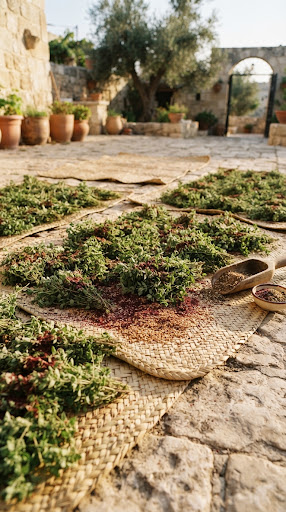
Traditional Za'atar Drying Techniques
If you want proper wild za'atar — the sharp, peppery kind, not the mild stuff — you have to catch it at exactly the right moment. Our members who forage it know the window is short: right before the plant flowers, usually the last two weeks of spring. Too early and the leaves haven't built up their oils yet. Too late, once it's flowered, and a lot of that smell has already drifted off into the air. Most of our foragers don't use a calendar for this. They just check the shine on the leaves and feel for how tight the buds still are.
Once it's cut, nobody dries it in the sun. It goes out in thin layers on reed mats, somewhere shaded — a covered terrace, a stone courtyard — and just sits there for four to seven days depending on how humid it is. Direct sun bleaches it and burns off the same oils you're trying to keep. Shade drying takes longer, but that's the only way to end up with something that still smells like anything once it's dry.
After that comes the part nobody enjoys but everyone does anyway: stripping the leaves off the stems by hand. It's usually a group of women sitting together doing it, which at least makes the boring part go faster since you're talking the whole time. The leaves get rubbed between your palms to squeeze out a bit more of the oil, sieved, and then mixed with roasted sesame, sumac and salt — in whatever ratio your family has always used. Ours isn't the same as our neighbor's, and neither of us is changing it.
We ran two workshops this year for members' daughters who grew up eating za'atar but had never actually made it from scratch. One of them told us afterward, "My teta used to just do it by feel, no measuring anything, and now I finally get what her hands were doing." That's really the whole point of running these — keeping it in people's hands, not just on the shelf.