
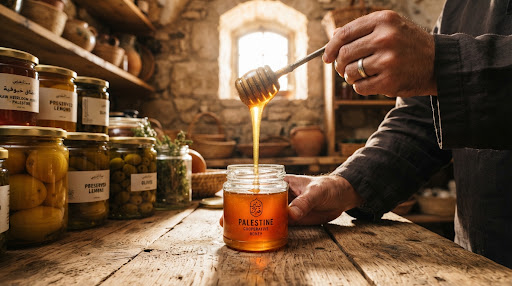
How Our Wildflower Honey Is Actually Made
Our hives are spread out across the hills around Salfit, usually tucked near slopes too steep or rocky to farm, where wild sage, thyme, mustard and a dozen flowers nobody's bothered to name all bloom at different times between February and October. That mix is what gives the honey its flavor, and honestly the spring batch and the late-summer batch don't taste much like each other at all.
Getting the honey out is still done the old way — frames pulled by hand, uncapped with a heated knife, spun in a small hand-cranked extractor instead of anything industrial. It only gets strained through a coarse mesh, just enough to catch wax bits, not fine enough to strip out the pollen and enzymes that make raw honey worth having in the first place. Nothing gets heated past whatever temperature the hive itself runs at.
Older members have used this honey as medicine for as long as anyone can remember — in warm water with lemon for a sore throat, straight onto a small cut or burn, a spoonful when someone's coming down with something. We're not going to stand here and make medical claims, but it's nice when what your grandmother always said turns out to line up with what the research says now too.
"Every hive's got its own mood, like it belongs to a different house," one of our three beekeepers said, only half joking — he's kept the same twelve hives for eleven years. With bees under pressure everywhere from lost habitat and pesticides drifting in from elsewhere, we're raising money to set up ten more hives on protected land next season, plus a beekeeping course for anyone who wants to learn from nothing.